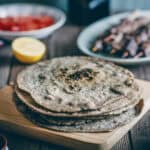
Buckwheat Pita Bread
Soft and flexible gluten-free buckwheat pita bread made with psyllium husk, olive oil and buttermilk. Perfect for wraps, dipping and serving alongside soups or Greek dishes.
Servings 6 pita breads
Calories 243kcal
Ingredients
- 300 ml water
- 13 g psyllium husk powder (Note 1)
- 340 g buckwheat flour
- 8 g baking powder
- 1 teaspoon salt
- 50 ml buttermilk (Note 2)
- 30 ml olive oil (Note 3)
Instructions
Make the dough
- In a large bowl whisk together the water and psyllium husk powder. Set aside for 10 minutes until thick and gel-like.
- In another bowl combine the buckwheat flour, baking powder and salt.
- Add the psyllium mixture to the dry ingredients along with the buttermilk and olive oil. Mix until a soft dough forms. The dough will be slightly sticky. (Note 4)
Shape the pita
- Divide the dough into 8 equal portions. Using lightly oiled hands shape each portion into a ball.
- Place each dough ball between two sheets of parchment paper and flatten into rustic pita shapes approximately 15-16cm wide. (Note 5)
Cook the pita
- Heat a well-seasoned cast iron or non-stick pan over medium-high heat.
- Carefully peel the pita from the parchment paper and cook for 2 minutes on each side until lightly charred and cooked through. (Note 6)
- Wrap the cooked pita in a clean tea towel to help keep them soft and warm.
Notes
- This recipe was tested using psyllium husk powder, not whole psyllium husks. The powder is essential for structure and flexibility in gluten-free baking.
- Buttermilk helps keep the pita soft and tender. Greek yogurt or sour cream can also be used.
- Don’t be shy with the olive oil - it helps keep the dough supple and prevents sticking during cooking.
- Resist the urge to add extra flour. It may seem tempting, but too much flour can make the pita dry and dense once cooked.
- The dough is naturally delicate, so lightly oiled hands and parchment paper make shaping much easier.
- Do not oil the pan. The dough itself should already be well oiled before cooking. If the pita feel too thin or fragile, shape them slightly thicker and cook a little longer.
Nutrition
Serving: 1Pita | Calories: 243kcal | Carbohydrates: 43g | Protein: 7g | Fat: 7g | Saturated Fat: 1g